
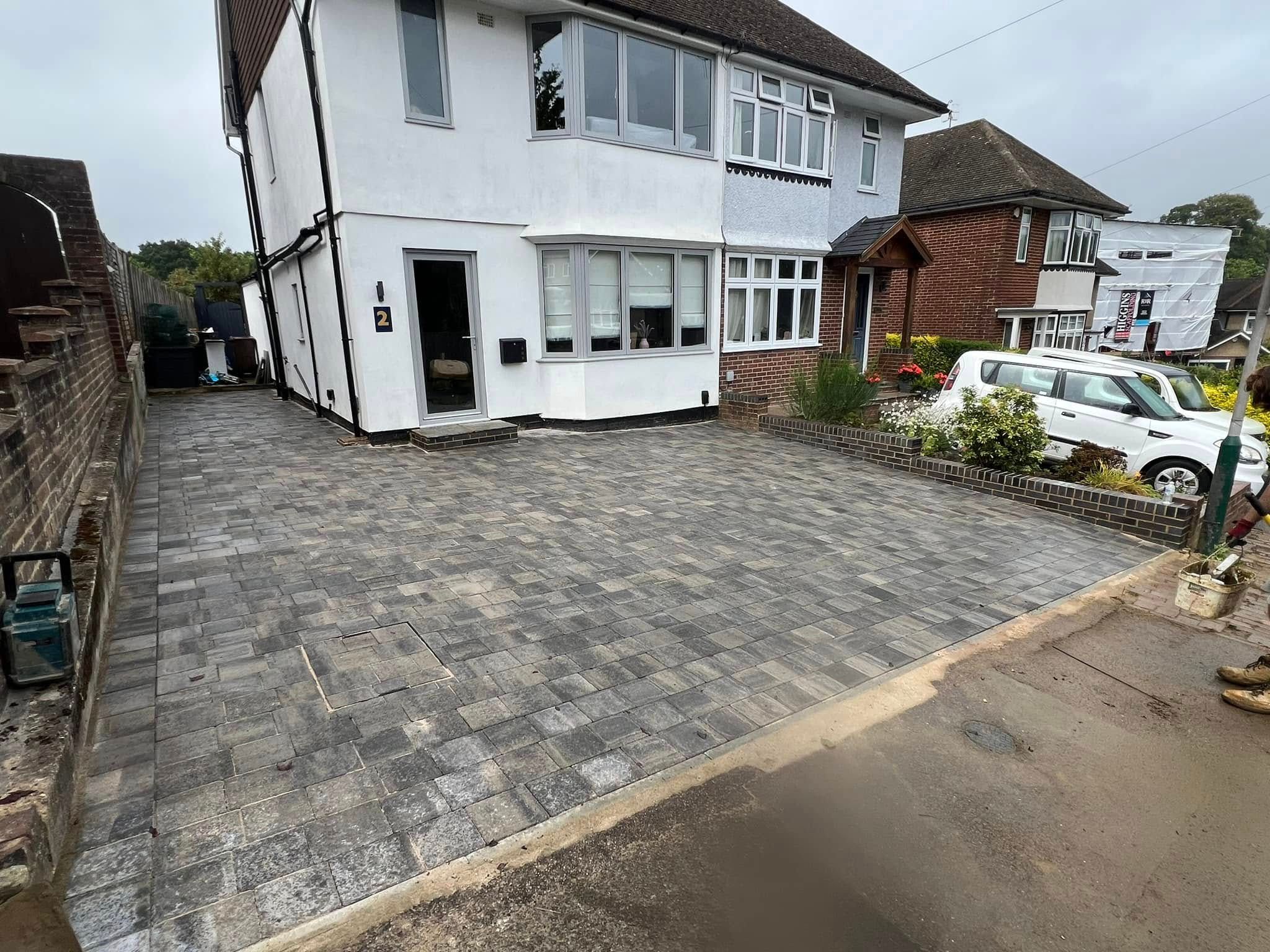
Block paving or resin bound? Kent homeowners are choosing between these two driveway surfaces more than ever. Here's the honest comparison — costs, durability, maintenance, and which one wins for your property.
It's the question that comes up on almost every driveway consultation across Kent right now. You've decided you want a new driveway — the old tarmac is cracked, the concrete is lifting, or there simply isn't one and you want to create proper off-road parking. You've done some research. You've seen block paving on your neighbour's drive and you've seen that smooth, speckled resin surface somewhere else. And now you're trying to figure out which one actually makes more sense for your home, your budget, and your life.
The honest answer is: it depends. Not on what's fashionable or what costs less upfront, but on your specific property, your soil conditions, your aesthetic preferences, and how you actually want to use and maintain the surface over the years ahead.
This guide gives you the full, unvarnished comparison — how each surface is installed, how it performs over time, what it costs, what maintenance it actually needs, and the specific situations where one clearly outperforms the other. By the end, you'll know which choice is right for you — or at least know the right questions to ask any contractor you speak to.
First: Why the Surface Choice Matters Less Than You Think
Here's something most driveway contractors won't tell you upfront, because it complicates the sales conversation.
The surface material — whether it's block paving or resin-bound gravel — is not what determines whether your driveway lasts twenty years or starts failing in three. What determines that is the sub-base underneath it.
A block-paved driveway laid on 150mm of properly compacted Type 1 MOT hardcore over a geotextile membrane will outlast a resin-bound surface laid on a thin, poorly prepared base every single time. And the reverse is equally true. The quality of the installation — specifically the depth and compaction of the sub-base, the drainage provision, and the edge restraint detail — is what you're really paying for when you commission a driveway.
That said, the surface material does matter. It affects the appearance, the maintenance requirements, the planning compliance, the long-term performance in specific conditions, and the cost. Understanding the genuine differences — rather than the marketing versions of those differences — is what this article is about.
Marshall Brickwork & Construction installs both block paving and resin-bound driveways across Kent to the same rigorous sub-base specification. When the team visits your site for a free consultation, their recommendation on surface type is based on what's actually right for your property — not what's easiest to sell.
Block Paving: The Classic That Earns Its Dominance
Block paving has been the most popular residential driveway surface in the UK for decades. That longevity isn't inertia — it reflects a surface type that genuinely performs well across a wide range of conditions, budgets, and property types.
How It's Installed
Block paving installation follows a specific sequence that, when executed correctly, produces a surface capable of lasting thirty years or more.
The existing surface is removed and excavated to the correct formation level — typically 200-250mm below finished surface height for a car-bearing driveway. A geotextile membrane is laid across the formation, followed by a minimum 150mm of compacted Type 1 MOT limestone hardcore in layers, each vibration-compacted before the next is applied. Haunched concrete edging restraints are installed at the perimeter before the surface is laid — these are critical and often skimped on by contractors cutting costs.
A 40mm layer of sharp sand is screeded to a consistent level and gradient. Blocks are laid in the chosen bond pattern — herringbone for maximum stability under vehicle loads, stretcher bond or basket weave for a cleaner aesthetic — butt-jointed and vibrated into the bedding with a rubber-soled plate compactor. Kiln-dried jointing sand is swept in to lock the surface, and the finished drive is vibrated again to consolidate.
The key variables that determine long-term performance: excavation depth, sub-base compaction, edge restraint quality, and drainage falls. These are invisible once the job is done. They're also where the difference between a quality installation and a cheap one lives.
What Block Paving Does Well
Repairability. This is block paving's biggest practical advantage. If a water main bursts under your drive, or you need access to drainage pipes or cables at any point, individual blocks can be lifted cleanly, the work done, and the surface reinstated. You can replace a dozen damaged blocks without demolishing the whole driveway. No other surface type offers this.
Pattern and design flexibility. Herringbone, stretcher bond, basket weave, running bond — each creates a genuinely different visual character. Contrasting borders, feature panels, colour blends — the design range is virtually unlimited. For homeowners who want a driveway that's visually distinctive or that complements a specific property style, block paving offers far more creative scope than resin.
Longevity under load. A well-laid block-paved driveway handles heavy vehicle loads extremely well. The interlocking block format distributes load across the surface rather than concentrating it at specific points, which is why block paving is standard on commercial car parks and loading areas as well as residential drives.
Wide material range. From budget concrete blocks through to premium clay pavers, tumbled granite setts, and large-format porcelain — the "block paving" category covers an enormous range of materials, finishes, and price points.
Established performance data. Block paving has been in widespread use long enough that its long-term performance characteristics are well understood. A properly installed block-paved drive will still be performing well in twenty to thirty years.
Where Block Paving Has Limitations
Weed and moss growth. The jointing sand between blocks is the natural medium for weed germination and moss establishment. On a well-maintained drive this is manageable — annual treatment in autumn, periodic sand topping-up — but it's an ongoing maintenance commitment that resin-bound surfaces don't require.
Planning compliance on front gardens. Since 2008, hard-surfacing a front garden over 5m² with a non-permeable surface requires drainage provision. Standard block paving without permeable jointing is impermeable, which means you either need a channel drain and soakaway, or you need to specify permeable block paving with permeable bedding and jointing. This adds cost and complexity. Permeable block paving resolves the compliance issue and is available in most standard block ranges.
Visual variation between batches. If your drive is extended or partially replaced years later, matching the original block colour and texture exactly can be difficult — manufacturers change batch formulations over time. This is a minor consideration but worth noting for the long term.
Resin Bound: The Contemporary Choice Gaining Ground Fast
Resin-bound gravel has moved from a premium niche product to one of the most frequently requested driveway surfaces across Kent over the past five years. The reasons are specific and practical.
How It's Installed
Resin-bound gravel is typically applied over an existing or new tarmac or concrete base, or over a compacted MOT sub-base with a tarmac binder course. The aggregate — natural gravel, quartzite, marble, or recycled glass in a range of colour blends — is mixed with a UV-stable polyurethane resin at a precise ratio, then applied at a consistent depth (typically 15-18mm) and trowelled to a smooth, even finish.
The installation is more time-sensitive than block paving. The resin has a defined open time — typically 30-60 minutes depending on temperature — during which it must be applied and finished. Temperature and humidity affect both the workability and the curing. A good installation team works efficiently and reads the conditions; a poor one rushes, or works in unsuitable weather, and the results are visible.
The surface cures over 24-48 hours and achieves full strength within a week. Traffic should be avoided during the curing period.
What Resin Bound Does Well
Full permeability — planning compliance without additional drainage. This is resin-bound's headline practical advantage. Water drains through the surface, through the sub-base, and into the ground below. No additional drainage infrastructure required for front garden installations. No channel drains. No soakaways. This simplifies both the installation and the compliance picture significantly.
Weed resistance. The resin matrix between aggregate particles leaves no gaps for weed seeds to establish. Resin-bound surfaces are genuinely low-maintenance in terms of biological growth — no annual moss treatment, no jointing sand to top up, no weeds appearing in the surface.
Contemporary aesthetic. The smooth, speckled finish — available in an extensive range of aggregate colours, blends, and textures — has a clean, architectural quality that works exceptionally well with contemporary property styles and new builds. The range of natural stone aggregates also produces surfaces that look premium without the complexity of natural stone slab installation.
Low maintenance profile. Beyond occasional sweeping and a periodic low-pressure wash, a properly installed resin-bound surface requires minimal attention. No jointing sand. No sealing. No moss treatment. For homeowners who want a surface they can genuinely forget about, resin is the lowest-maintenance option available.
Seamless edge-to-edge finish. Unlike block paving, which requires edge restraints and has a defined perimeter detail, resin-bound can flow seamlessly to drainage channels, planting areas, and property boundaries, creating a clean, continuous surface.
Where Resin Bound Has Limitations
No repairability. This is the significant practical downside. If drainage or utility work is needed under a resin-bound driveway, the surface must be cut and the repaired section cannot be invisibly reinstated — the colour and texture of new resin won't match aged existing resin. A patched resin-bound drive shows the patch. This isn't usually a problem, but it's worth understanding before committing.
Installation conditions matter significantly. Resin-bound cannot be installed when it's raining, when temperatures are below 5°C, or in high humidity conditions. In Kent's climate, this limits the practical installation window more than block paving. An inexperienced team that ignores these constraints produces a surface that debonds, blisters, or cures with an inconsistent finish.
Quality variation is significant. The resin-bound market has a wide quality range. Cheap UV-unstable resins fade and yellow within a few years. Aggregate that isn't fully dried before mixing produces a weak bond. Insufficient depth produces a fragile surface prone to cracking. The premium products and experienced installation teams produce excellent results; the budget end of the market produces disappointment. Choosing your contractor carefully matters more with resin-bound than with almost any other surface type.
Lifespan under heavy loads. Resin-bound is well proven for standard domestic vehicles. For heavy vehicles — larger vans, commercial vehicles, 4x4s with trailers — block paving or tarmac is typically more appropriate for the high-traffic areas of the drive.
The Direct Comparison: Six Key Factors
Cost
Block paving: £80–£130 per square metre installed, including correct sub-base. A 40m² double driveway: £3,200–£5,200.
Resin-bound: £70–£120 per square metre for a quality installation. A 40m² double driveway: £2,800–£4,800.
The headline costs are similar. Resin-bound can be slightly cheaper on larger areas because it installs faster; block paving can be cheaper on smaller areas because the material cost is lower. The quality of the sub-base preparation — which should be the same for both — is the primary cost driver.
Be cautious of resin-bound quotes below £50/m² — they almost always reflect either cheap resin or inadequate preparation. The long-term cost of a failing resin surface is significantly higher than the upfront saving.
Durability
Both surfaces are highly durable when correctly installed. Block paving has the longer proven track record — 25-30 year lifespans are common on well-maintained drives. Resin-bound has a shorter performance history but quality products are proving durable at 15-20 years. For both, the sub-base determines the structural longevity; the surface material determines the aesthetic longevity.
Maintenance
Block paving requires ongoing maintenance: annual moss/weed treatment, periodic jointing sand replacement, occasional sealing. Budget 2-3 hours per year and £30-50 in products.
Resin-bound requires minimal maintenance: periodic sweeping and an occasional wash. Essentially zero ongoing cost or time commitment.
Winner on maintenance: Resin-bound — by a significant margin.
Planning Compliance
Standard block paving on front gardens over 5m² requires drainage provision (channel drain and soakaway) or permeable specification. Additional cost and complexity.
Resin-bound is inherently permeable. No additional drainage infrastructure required. Full planning compliance without extras.
Winner on planning: Resin-bound — simpler and cheaper to make compliant.
Design Flexibility
Block paving offers significantly more design scope — patterns, bonds, colours, borders, feature panels, mixed materials. For homeowners who want a distinctive or complex design, block paving has no equal.
Resin-bound offers a range of aggregate colours and blends but a single surface format. The aesthetic is clean and contemporary but less variable.
Winner on design: Block paving — substantially more creative scope.
Suitability for Kent's Ground Conditions
For properties on the clay-heavy soils common across much of Sittingbourne, the Medway towns, and mid-Kent generally, both surfaces require an enhanced sub-base to manage seasonal ground movement. The driveway groundworks specification for clay soils involves additional depth and geotextile provision regardless of surface type.
For properties on chalk downland soils (North Downs, parts of east Kent), drainage is less of a concern and both surfaces perform well on a standard specification.
In coastal areas (Thanet, Folkestone, Dover), resin-bound's resistance to salt air and its impermeable surface make it a marginally better performer in exposed positions.
Which Should You Choose?
Here's an honest decision framework:
Choose block paving if:
- You have a complex or decorative design in mind
- Heavy vehicles use the drive regularly
- You might need underground access at some point
- You prefer a traditional or period-appropriate aesthetic
- You want maximum design flexibility and aren't deterred by some ongoing maintenance
Choose resin-bound if:
- You want a contemporary, clean finish with minimal maintenance
- Your drive is on a front garden and you want the simplest planning compliance route
- You have a large area where the fast installation of resin reduces cost
- You're in a coastal or exposed location
- Low maintenance is your primary priority
Either works equally well if:
- The sub-base is specified and installed correctly
- The contractor knows what they're doing with the specific material
- Drainage is properly addressed from the outset
Getting the Right Advice for Your Specific Property
The honest truth is that both surfaces are excellent choices when properly installed. The decision should be made based on your specific property, its ground conditions, your aesthetic preferences, and your maintenance appetite — not on which one a contractor happens to prefer to install.
Marshall Brickwork & Construction installs both block paving and resin-bound driveways across Kent. The team visits every site before making a recommendation — assessing ground conditions, drainage, planning requirements, and design preferences — and gives you an honest view of which option suits your specific situation best.
Browse completed driveway projects across both surface types. Explore the full driveway construction services in detail. Read the complete driveway construction guide for the full picture on sub-base specification, drainage, and costs. And for Sittingbourne homeowners specifically, the Sittingbourne construction guide covers the specific local soil conditions that affect both surface types in that area.
When you're ready to discuss your specific project — free site visit, no-obligation quote, honest recommendation:
Phone: 07724 730872 Email: info@mbconstruction.group Contact: mbconstruction.group/contact/
Frequently Asked Questions
Can resin-bound be laid over my existing driveway? Sometimes yes — if the existing surface is sound, stable, and bound (tarmac or concrete), resin-bound can be applied directly over it, which reduces preparation cost. If the existing surface has movement, cracking, or structural issues, those problems will telegraph through the resin. A site assessment determines which approach is appropriate.
How long does each surface take to install? A typical 40m² driveway: block paving takes 3–5 days including base preparation. Resin-bound on an existing base takes 1–2 days; on a new base, add 2–3 days for base preparation.
Does block paving add more value to a property than resin-bound? Both add kerb appeal and property value when professionally installed. The difference is marginal — a quality installation of either surface creates a strong first impression. The sub-base quality is what determines whether that value is maintained long-term.
Can I get resin-bound in a colour that matches my house? Resin-bound is available in a very wide range of natural stone colours — from pale creams and silvers through warm golds and terracottas to dark charcoals. Most properties can be matched effectively. Marshall's team will show you samples during the consultation.
Is resin-bound slippery when wet? Quality resin-bound with the correct aggregate specification has good slip resistance, including when wet. Avoid smooth or polished aggregate blends for driveways. The standard natural gravel and quartzite blends used by Marshall provide appropriate grip.
What about block paving in a conservation area? In conservation areas, the surface material, colour, and pattern may be subject to planning restrictions. Marshall's team knows the local planning picture across Kent's conservation areas and will advise where restrictions apply before you commit to any specification.
Marshall Brickwork & Construction Ltd | Rochester, Kent | 07724 730872 | mbconstruction.group