
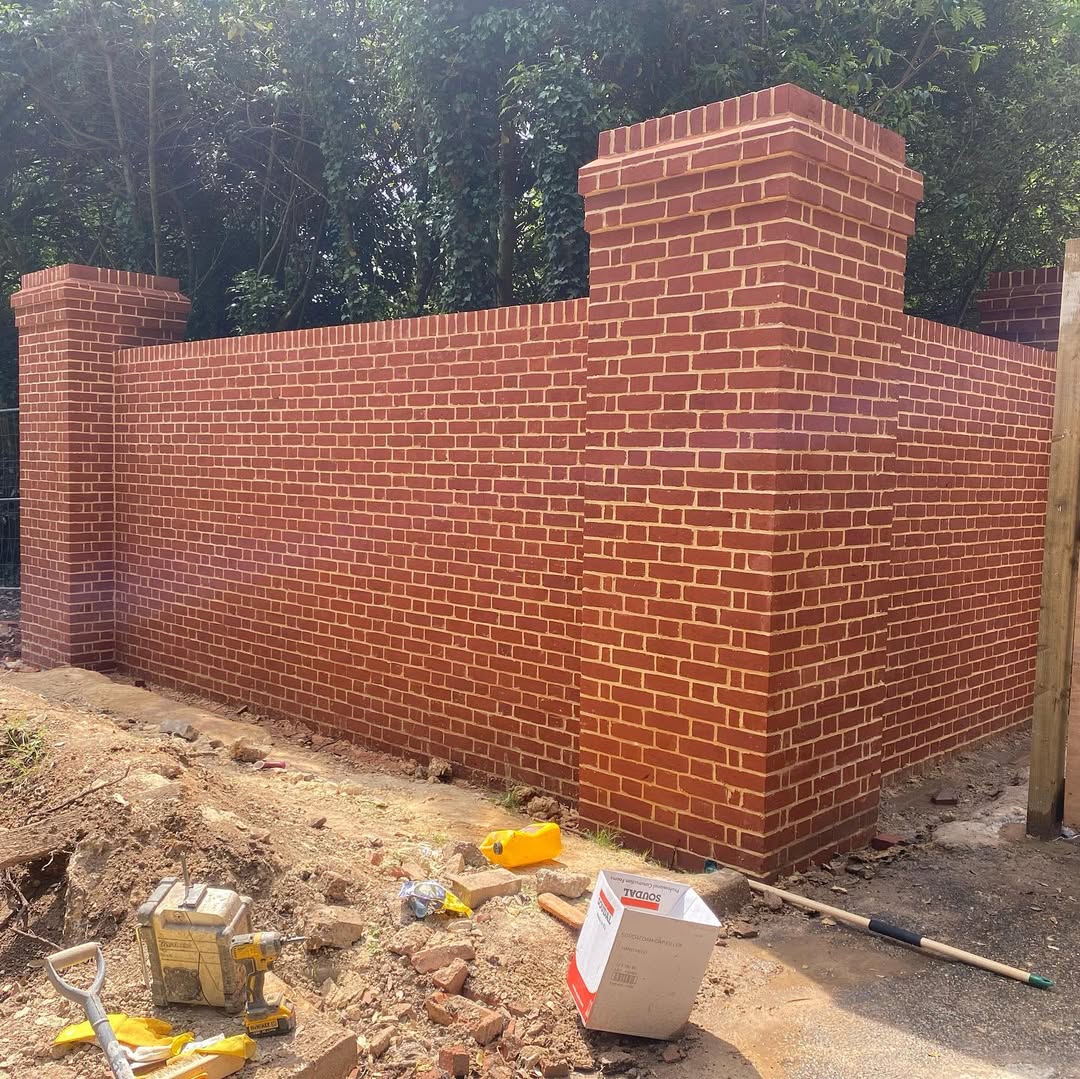
Commercial brickwork in Kent demands more than a builder who can lay bricks straight. Business owners, developers, and property managers need contractors who understand programme management, compliance documentation, multi-trade coordination, and the specific technical requirements that commercial projects carry — from movement joint design and cavity wall tie specification to brick selection for frost resistance and heritage-sensitive approaches in Kent's many conservation areas. This guide covers everything the commercial client needs to know: the types of commercial brickwork projects across Kent, what genuinely capable contractors look like versus those who overstate their commercial experience, the specification details that determine long-term performance, the most common commercial brickwork mistakes and how to avoid them, and what working with Marshall Brickwork & Construction on a commercial project actually looks like.
There's a version of this article that leads with a list of services and ends with a phone number.
You've seen that article. Every competitor in this space has written it. "We offer commercial brickwork across Kent. We're experienced, professional, and competitively priced. Call us today."
It tells you nothing useful. And if you're a business owner, a developer, a property manager, or a facilities professional responsible for commissioning and overseeing construction work, you don't need a list. You need to understand what commercial brickwork actually involves, why it fails when it does, what separates a contractor capable of delivering at commercial level from one who isn't, and how to protect your project, your timeline, and your budget.
That's what this guide covers.
And yes — Marshall Brickwork & Construction delivers commercial brickwork across Kent and into Greater London. But we'll earn that recommendation by being genuinely useful first.
What Commercial Brickwork Actually Means — and Why It Differs From Residential
The distinction between commercial and residential brickwork isn't just about scale. A large residential extension might involve more brickwork than a small retail unit refurbishment. The differences are operational and technical, and they matter in specific, practical ways.
Compliance requirements are more complex. Commercial construction in England operates within a more demanding regulatory framework than residential work. Building Regulations apply with greater rigour. Where permitted development rights allow many domestic alterations without approval, commercial works almost always require formal consents — and often involve planning conditions that specify material types, face finishes, or bond patterns that must be followed precisely. In Kent's numerous conservation areas — which include significant commercial zones in Rochester, Faversham, Canterbury, and Tunbridge Wells — listed building considerations and conservation area consents add further layers of compliance obligation.
A contractor working on commercial projects needs to understand this landscape, manage compliance proactively, and produce the documentation that demonstrates it. Not every brickwork contractor does.
Programme management is business-critical. When a retail unit can't open because the external brickwork isn't complete, that's not an inconvenience — it's a direct financial loss for the client, the tenant, and potentially other parties in the supply chain. When a housing development's brick skin falls behind programme, it delays handover, affects cashflow, and potentially triggers contractual penalties.
Commercial clients need contractors who understand that programme certainty is a client right, not a favour. Who build schedules with realistic contingency. Who communicate proactively when anything threatens to affect the timeline — not reactively when the damage is already done.
Coordination with other trades is the norm. Residential projects occasionally involve multiple contractors. Commercial projects almost always do. The brickwork contractor is typically one element of a wider construction programme, working alongside groundworks teams, steel erectors, roofing contractors, M&E trades, and principal contractors managing the overall site.
Operating effectively in that environment requires site management experience, professional conduct in multi-trade environments, and the ability to manage interfaces and handover points between different scopes of work without causing delays or creating conflicts.
Volume and consistency demand different team organisation. A commercial housing development might require thousands of square metres of facing brickwork delivered to a consistent standard across multiple phases. A large retail or industrial development might need the same bond pattern and joint specification maintained across an entire elevation built over weeks by a rotating team. Achieving this level of consistency requires supervision, quality control processes, and a team depth that smaller residential contractors don't typically have.
Marshall Brickwork & Construction's commercial capability has been developed across 15 years of projects that span both residential and commercial sectors. The team brings craft credentials to commercial work, combined with the project management discipline and compliance awareness that commercial clients require.
The Types of Commercial Brickwork Projects in Kent
Kent's commercial economy is diverse, and the brickwork requirements that flow from it cover a wide range of project types.
Retail and Hospitality
Retail units, restaurant premises, hotel developments, and mixed-use commercial/residential schemes all involve brickwork that must meet both structural and aesthetic requirements — often with tight programme constraints driven by tenant occupation dates or franchise opening commitments.
Facing brickwork on retail premises is typically specified to match the character of the surrounding townscape, particularly in Kent's historic town centres where planning requirements can be very specific. The brickwork may be structural, or it may be a facing skin over a steel or concrete frame. Both require different specification approaches and different installation techniques.
Hospitality premises — particularly hotels and larger restaurants — often involve significant external brickwork to create character and kerb appeal. Getting the specification right in terms of brick type, bond pattern, and joint profile is critical when the aesthetic is central to the brand identity of the business.
Industrial and Warehousing
Kent's strategic position between London and the Channel ports has driven sustained demand for industrial and logistics development — warehouses, distribution centres, trade counters, and light industrial units across locations including Swanley, Dartford, Sittingbourne, and the Medway towns.
Industrial brickwork is typically functional rather than decorative — skin walls and panel walls to structural steel or concrete frames, boundary walls and service yard walls, and security brickwork around site perimeters. The specification priority is structural performance and durability. Durability in an industrial context often means resistance to impact, chemical exposure, and severe frost — requirements that affect brick selection, mortar specification, and jointing in specific ways.
Housing Developments and New Build
Residential housing development represents the largest volume of commercial brickwork in Kent by far. The county's development pipeline — driven by the strategic housing targets of the various local planning authorities — means there is consistent, substantial demand for facing brickwork to new housing schemes across the county.
Commercial housing brickwork involves specific technical requirements: compliance with NHBC standards, cavity wall construction to current building regulations, correct installation of wall ties, cavity closers, and cavity trays, and facing work that meets the planning and design code requirements of each specific scheme.
The extensions and new builds capability at Marshall Brickwork & Construction sits at the intersection of residential and commercial brickwork — smaller schemes delivered with the craft quality that individual homeowners expect and the programme management that commercial clients require.
Property Refurbishment and Maintenance
Property managers and commercial landlords across Kent maintain portfolios that require ongoing brickwork attention. Repointing deteriorating external elevations, repairing damaged or failed sections, addressing water ingress problems caused by failed detailing — this maintenance brickwork is lower-profile than new construction, but it's commercially significant and requires the same levels of technical knowledge and execution quality.
Brick repair and repointing on commercial properties involves all of the same specification considerations as residential work — and often more, because commercial buildings are more exposed, larger in scale, and more likely to be in locations where scaffolding, access management, and health and safety compliance add operational complexity.
Commercial Groundworks and External Works
Beyond the brickwork itself, commercial properties require professionally executed external works — groundworks for car parks and service areas, block paving and hard-standing for customer and logistics access, boundary fencing and walls, and external landscaping to enhance the appearance and usability of the commercial environment.
Managing all of these as a single coordinated scope — rather than procuring multiple specialist contractors — simplifies the supply chain, improves programme management, and typically produces a more coherent finished result. Marshall's breadth of capability across all outdoor construction disciplines makes this single-supplier approach achievable.
What Good Commercial Brickwork Contractors Actually Look Like
The commercial brickwork contractor market in Kent ranges from large specialist firms focused exclusively on development-scale housing work, through mid-sized contractors serving the full commercial range, to smaller operations offering commercial work as a supplement to their residential focus.
Knowing which type of contractor is right for your project — and how to distinguish quality from mediocrity across the whole field — requires understanding what the differentiating factors actually are.
Verified Compliance and Insurance
Any commercial brickwork contractor must carry adequate public liability insurance for the scale of commercial work they undertake. Domestic PLI limits — typically £1-2 million — may be insufficient for larger commercial projects. Confirm the level of cover before appointment and ensure it's appropriate for your specific project and site.
Relevant accreditations — CSCS cards for all operatives, RAMS (Risk Assessment and Method Statement) capability, Health and Safety management documentation — are non-negotiable on commercial sites. A contractor who can't produce these quickly when asked isn't commercially ready.
Marshall Brickwork & Construction is fully licensed, bonded, and insured. The team operates to professional health and safety standards on every project.
Programme Management Capability
Ask any commercial contractor how they manage programme. What scheduling approach do they use? How do they communicate progress? What's their process when something threatens to impact the timeline?
The answers to these questions tell you more about commercial capability than any credentials document. A contractor who talks about milestones, interfaces, and proactive communication is one who's operated in a multi-trade commercial environment. One who answers vaguely or describes an approach that works fine for single-trade residential jobs is telling you something important about their commercial experience.
Quality Control Processes
On commercial projects — particularly larger ones where multiple operatives contribute to the same elevation over time — quality control processes are what maintain consistency. How does the contractor ensure the same joint width is maintained from week one to week four? How are deviations from the agreed specification identified and corrected? Who on site has quality assurance responsibility?
These aren't questions you'd ask on a residential project where the same two people do the whole job. They're essential questions for commercial work.
Track Record on Comparable Projects
Ask for examples of comparable commercial projects completed in the last two to three years. Not just photographs — project references you can actually contact. A contractor with genuine commercial experience will provide these comfortably. One who's overstating their commercial capability will become evasive.
The projects gallery at mbconstruction.group/projects/ shows completed work across both residential and commercial categories. It's a starting point for understanding the range and quality of delivery.
The Specification Details That Determine Commercial Brickwork Quality
Technical specification matters in commercial brickwork at least as much as in residential work. The consequences of specification errors are often more significant because the scale is larger and the compliance stakes are higher.
Brick Selection for Commercial Applications
Commercial brickwork is often specified by architects or structural engineers, and the brick selection will typically be documented in the specification. Where the client has discretion — in maintenance and refurbishment work particularly — the right brick selection involves several considerations.
Frost resistance. Bricks used in exposed positions on commercial buildings should be designated F2 (fully frost resistant) to the standard EN 771-1. Using F1 (moderately frost resistant) bricks in exposed positions is a common and consequential specification error that leads to rapid deterioration in the English climate.
Compressive strength. Structural applications have minimum compressive strength requirements. The specification should confirm the declared mean compressive strength of the brick meets or exceeds the design requirement. For facing work on commercial frames, this is often less critical; for load-bearing applications, it matters significantly.
Soluble salt content. Bricks with high soluble salt content can cause efflorescence — the white staining that appears on brick faces when soluble salts are carried to the surface by moisture. For commercial properties where external appearance is commercially important, specifying low soluble salt content (S1 or S2 designation) reduces this risk.
Visual consistency. Commercial projects often require facing brickwork to maintain consistent appearance across large elevations. This requires ensuring sufficient bricks from the same batch — or at minimum the same manufacturing run — are available for the whole project. Running out of matching bricks mid-project and trying to blend a new batch is a common cause of visible inconsistency in commercial facing work.
Mortar Specification in Commercial Contexts
The mortar specification principles that apply to residential brickwork apply equally to commercial work. In commercial contexts, additional considerations include:
Movement joint placement. Large commercial elevations require regular movement joints to accommodate thermal movement and prevent cracking. The design specifies joint locations, but the contractor must install them correctly — with the right flexible sealant, at the right width and depth, in the right position relative to the brick bond pattern.
Cavity wall construction details. Commercial cavity walls must be constructed with wall ties at the correct centres, cavity trays above openings, and appropriate cavity closers at jambs and sills. These are compliance requirements under Building Regulations Part L and Part C — not optional details.
Structural engineering compliance. Where brickwork is structural — supporting loads above it — the mortar designation (M2, M4, M6, or M12 in the current designation system) must match the structural engineer's specification. Substituting a weaker mortar to save cost is both a structural risk and a compliance failure.
Commercial Brickwork in Kent's Towns: Local Knowledge That Matters
Kent's commercial landscape is concentrated in a series of distinct town centres and commercial zones, each with its own planning character, architectural context, and regulatory environment.
Medway towns — Rochester, Chatham, Gillingham, and Strood — combine significant commercial activity with substantial historic building stock. Rochester's conservation area and the presence of listed structures across all four towns means commercial brickwork in this zone frequently requires heritage-sensitive approaches and formal consent management.
Maidstone as the county town has a substantial commercial centre with mixed-age commercial stock, including significant regeneration activity. Commercial brickwork here spans the full range from new build commercial development through to heritage restoration on the town centre's older buildings.
Sittingbourne and Swale have seen significant industrial and logistics development, driven by transport links and the availability of development land. Commercial brickwork in this zone tends toward industrial and distribution applications.
Tonbridge, Tunbridge Wells, and Sevenoaks have affluent commercial environments with high expectations for finish quality and a planning context that's sensitive to visual character. Facing brick selection and joint quality are particularly scrutinised in these locations.
Ashford and the Kent coast — Folkestone, Dover, Whitstable, and Margate — each have specific commercial brickwork demands shaped by their economic character and coastal exposure conditions.
Marshall Brickwork & Construction operates across all of these areas. Based in Rochester at the heart of the Medway towns, with coverage extending across the full county and into Greater London and Surrey, the team's local knowledge spans the full range of Kent's commercial brickwork environments.
The Commercial Client Experience: What Working With Marshall Looks Like
Commercial clients have different expectations from the initial enquiry process through to project completion, and Marshall's approach to commercial work reflects that.
Initial consultation. Commercial enquiries get a prompt, professional response. Whether you're a property manager needing a maintenance assessment, a developer procuring brickwork for a housing scheme, or a business owner planning premises improvements, the team will discuss your specific requirements, provide an indication of approach and timeline, and arrange a site visit where appropriate.
Detailed specification and quotation. Commercial quotes are detailed and specific. The specification — brick type, bond pattern, mortar designation, joint profile, movement joint positions, compliance documentation — is documented clearly. The programme is outlined with milestones. The price is fixed within the agreed scope.
On-site delivery. Work starts on time. The team integrates professionally with other trades on site. Progress is communicated proactively. Any issues that affect programme or cost are raised immediately and handled transparently.
Compliance documentation. Health and safety documentation, RAMS, inspection records, and completion certificates are available throughout the project and provided at handover. Commercial clients get the paperwork they need without having to chase for it.
Workmanship guarantee. All commercial work is covered by Marshall's workmanship guarantee. For commercial clients, this means confidence that the relationship doesn't end at practical completion.
To discuss a commercial brickwork project — of any scale, anywhere in Kent or Greater London — contact the team on 07724 730872, at info@mbconstruction.group, or through the contact page.
Frequently Asked Questions: Commercial Brickwork in Kent
Can Marshall handle large-scale commercial housing developments? Yes. Marshall's team has the capacity and experience for commercial housing development brickwork alongside smaller commercial projects. For very large development programmes — multi-phase schemes requiring significant gang capacity — contact us to discuss programme, phasing, and resource planning.
Do you work as a subcontractor to principal contractors? Yes. Marshall regularly works in subcontract relationships with principal contractors on commercial sites. The team is experienced in operating within the site management structures that principal contractors establish, and provides all necessary compliance documentation as standard.
Can you match existing brickwork on a commercial refurbishment? Matching existing brickwork — both in brick type and mortar specification — is a key element of commercial refurbishment and maintenance work. Marshall's team is experienced in sourcing matching bricks, including from reclamation, and specifying mortar mixes that blend with aged existing pointing.
Do you provide written RAMS for commercial sites? Yes. Risk Assessments and Method Statements are produced for all commercial projects as standard. These are available prior to mobilisation and are updated if the scope of work changes during the project.
What areas in Kent do you cover for commercial work? Full county coverage across Kent, plus Greater London and select areas of Surrey and Sussex. For projects in these areas, contact us to confirm coverage and discuss logistics.
Can you also handle the external groundworks and paving for a commercial site? Yes — Marshall's breadth of capability covers commercial groundworks, block paving and hard-standing, boundary walls and fencing, and external landscaping alongside the brickwork. Managing all of these through a single contractor simplifies procurement and improves programme management.
The Bottom Line on Commercial Brickwork in Kent
The commercial brickwork market in Kent has plenty of operators. The differentiators that genuinely matter — programme reliability, compliance competence, consistent quality over large areas, professional conduct in multi-trade environments, and a track record of actually delivering what was agreed — are less common than they should be.
Marshall Brickwork & Construction brings fifteen years of brickwork expertise, a 5-star client rating across 500+ projects, and a professional operating model to commercial projects across Kent and beyond. The same craft standards that have built the company's residential reputation apply directly to commercial work — combined with the additional programme management and compliance capability that commercial clients require.
Explore completed work in the projects gallery. Read about the company's values and approach on the about page. Browse the full range of services to understand the complete scope of what Marshall can deliver for your commercial project. And visit the blog for more in-depth guides on brickwork, groundworks, driveways, patios and construction across Kent.
When you're ready to discuss a commercial project:
Phone: 07724 730872 Email: info@mbconstruction.group Contact form: mbconstruction.group/contact/ Address: 14 Poplar Road, Rochester, ME2 2NR
Marshall Brickwork & Construction Ltd — Building Excellence Since Day One. Licensed, insured, and trusted by commercial clients across Kent and Greater London.
Avoiding the Most Common Commercial Brickwork Mistakes
For anyone commissioning commercial brickwork in Kent — whether you've done it many times before or you're approaching it for the first time — these are the mistakes that come up most often and cost the most to fix.
Appointing on Price Without Evaluating Capability
Commercial brickwork procurement often involves competitive tendering, and the tendency to appoint the lowest compliant bid is understandable from a cost management perspective. The problem is that the lowest bid frequently reflects either a thinner specification (cutting corners on mortar, tie centres, or movement joint provision that are hard to verify mid-construction) or a contractor who has underpriced the job and will manage margin by cutting corners or generating variations.
The right procurement approach evaluates capability alongside price. A slightly higher bid from a contractor with a demonstrable track record, professional compliance documentation, and strong client references is almost always better value than the cheapest number on the spreadsheet.
Failing to Confirm Material Quantities Before Starting
One of the most disruptive and avoidable problems in commercial facing brickwork is running short of the specified brick mid-project, when the original batch is no longer available or has been discontinued. The visual difference between bricks from different manufacturing runs — even nominally the same product — can be significant enough to be obvious on a finished elevation.
Confirm that sufficient brick has been secured for the full project before work begins. For larger projects, this may mean ordering ahead of mobilisation and storing on site or at the supplier's depot. Marshall's commercial team manages this as standard procurement practice.
Neglecting Movement Joint Design and Installation
Movement joints are one of the most commonly missed or poorly executed elements of commercial brickwork. Designed to accommodate the thermal expansion and contraction of large masonry panels, they need to be positioned correctly (typically at 10-12 metre centres for clay brickwork, at returns and structural discontinuities), filled with a compatible flexible sealant, and maintained at the correct width throughout their depth.
Movement joints that are omitted, incorrectly positioned, or inadequately filled allow the brickwork to generate internal stresses that eventually cause cracking — often at the most visually prominent positions on the elevation. Fixing cracked brickwork on a commercial building is expensive and disruptive. Installing movement joints correctly in the first place costs nothing extra.
Overlooking Cavity Wall Tie Installation
In cavity wall commercial construction, wall ties are invisible once the work is complete but absolutely critical to structural performance. Ties must be installed at the correct horizontal and vertical centres, at the correct angle (sloping outward from the inner to the outer leaf to drain away from the cavity), and secured in mortar bed joints that are fully filled rather than partially bedded.
Structural failures in cavity wall construction — rare but serious — almost always involve failed or inadequate wall ties. Compliance inspection at the tie installation stage, either by a clerk of works or by the contractor's own quality control process, is the practical safeguard.
Not Planning for Access in the Programme
Scaffolding and access management on commercial sites is both a programme consideration and a safety obligation. Access for brickwork above three metres requires proper scaffolding — not hop-up platforms or tower scaffolding used inappropriately. On commercial sites where other trades are working simultaneously, scaffold design, loading, and management needs to be coordinated through the principal contractor.
Marshall's commercial team plans for access from the outset, incorporates scaffold lead times into the programme, and operates within the site's health and safety management framework throughout.
Mismanaging the Handover
Commercial brickwork completion should involve a proper inspection against the specification before practical completion is certified. Any defects — cracked joints, inconsistent bond patterns, incorrect movement joint installation, damage during construction — should be identified and made good before handover, not discovered by the client or their surveyor afterwards.
Marshall's projects include a completion inspection as standard. The workmanship guarantee that covers all completed work means any defects identified post-handover are addressed promptly and without dispute. Commercial clients have enough to manage without fighting their contractors over snagging items.
Why Marshall Is the Right Commercial Brickwork Partner in Kent
Choosing a commercial brickwork contractor is fundamentally a decision about trust. Trust that the specification will be followed. Trust that the programme will be managed. Trust that problems will be communicated honestly and resolved professionally. Trust that the workmanship will still be performing correctly in ten years.
Marshall Brickwork & Construction has built that trust across fifteen years and 500+ projects. The company's growth has been driven almost entirely by repeat business and referrals — the most reliable indicator of genuine client satisfaction in the construction industry.
For commercial brickwork across Kent and Greater London, the conversation starts with a phone call or an email. There's no obligation, no pressure, and no vague promises — just an honest assessment of what your project requires and whether Marshall is the right fit to deliver it.
Explore the services page for the full picture of what the team offers, visit the projects gallery to see real completed work, and read more practical guides on the blog — including deep-dives on professional brickwork in Kent, brick repair, and choosing the right construction company in Kent.
07724 730872 | info@mbconstruction.group | mbconstruction.group/contact/