
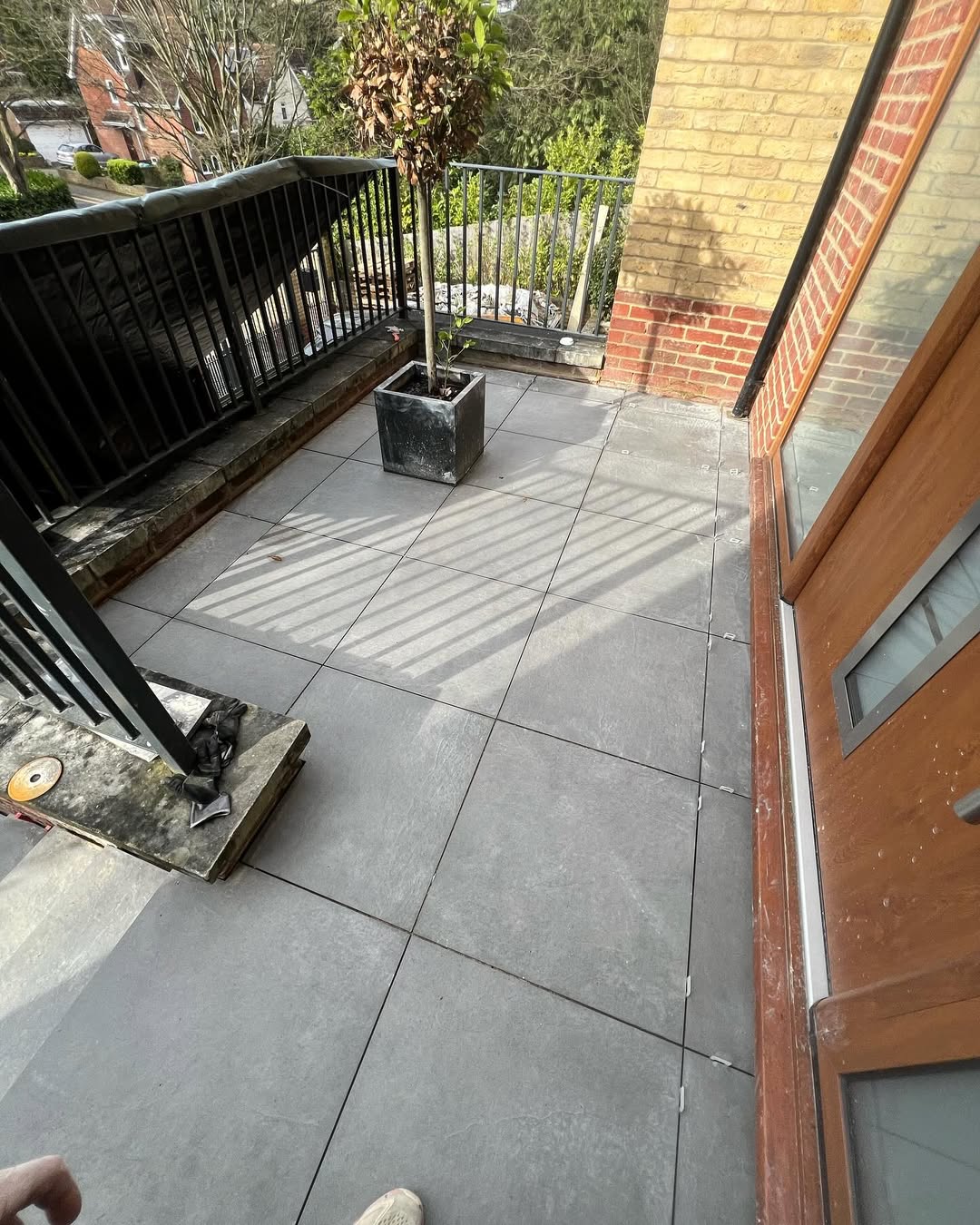
A patio is one of the most rewarding investments a Kent homeowner can make — but only when it's built on a correct specification. This definitive guide to patio construction in Kent covers every major surface material from Indian sandstone and large-format porcelain to limestone, granite, brick, and concrete paving, with honest assessments of what each requires to perform properly. You'll find the sub-base and bedding layer details that determine whether your patio lasts three years or thirty, realistic 2026 cost ranges, design principles that produce better outdoor spaces, the most common mistakes contractors make and how to avoid them, and a complete FAQ covering everything from planning permission to maintenance. If you're planning a new patio anywhere in Kent, this is the guide to read before you commission anything.
There's a particular kind of disappointment that only homeowners who've had building work done badly can truly appreciate. The patio looked beautiful on day one. The colour was right, the layout was right, the material was exactly what you'd chosen. Six months later you noticed the first crack. A year after that, a corner had sunk. By year three, the whole surface had a distinct lean, there was a puddle forming by the back door every time it rained, and two of the larger slabs had cracked clean through.
Not because the material was wrong. Not because the design was bad. Because the preparation underneath it was inadequate.
Patio construction in Kent is one of those investments where the visible result — the stones, the pattern, the colour, the grout — tells you almost nothing about whether the job was done properly. Everything that determines long-term performance is invisible once the surface is laid. And that gap between what you can see and what actually matters is exactly where the difference between a patio that lasts thirty years and one that needs relaying in five is decided.
This guide gives you everything you need to commission a patio that genuinely lasts — the right materials questions, the specification detail that separates good work from poor, realistic costs, and a clear framework for choosing a contractor who knows what they're doing.
Why a Patio Is One of the Smartest Investments You Can Make in a Kent Property
Kent's outdoor living season is longer than most homeowners fully exploit. From March through October — sometimes beyond — a well-designed outdoor space is usable for entertaining, relaxing, and extending the functional square footage of your home in a way that no indoor room can replicate. The psychological shift that comes from having a genuinely well-made, well-designed outdoor space is real: you use the garden differently. You spend more time in it. The home feels bigger and more connected to its surroundings.
From a pure property value perspective, a quality patio installation consistently delivers a strong return. Estate agents across Kent report that well-maintained, professionally installed outdoor living spaces are among the most influential factors in buyer decisions — particularly for family buyers who use the outdoor space as an extension of the home rather than simply a lawn to be managed.
And unlike many property improvements, a patio that's done properly is genuinely low-maintenance. You're not repainting it, not re-turfing it, not replacing it. A patio laid on a correct base, with the right material and proper drainage, is essentially a permanent feature of the property. The return on investment gets better every year it stands.
The patios and slabbing services delivered by Marshall Brickwork & Construction reflect exactly this principle — properly engineered outdoor surfaces built to be a permanent improvement, not a temporary cosmetic fix.
The Full Range of Patio Materials: An Honest Assessment
The choice of surface material is what most homeowners start with — and understandably so, since it's what you look at every day. Here's an honest breakdown of every major option and what each one requires to perform as it should.
Indian Sandstone: The Nation's Favourite for Good Reason
Indian sandstone has been the most popular natural stone patio material in the UK for over two decades, and it earns that position. The warm, earthy tones — ranging from silver-grey and buff through golden and riven multicolour — complement both traditional and contemporary garden designs. The natural variation in colour and texture across each slab is part of its appeal; no two Indian sandstone patios look exactly the same.
The practical credentials are solid: when properly sealed, sandstone is resistant to staining and weathering, and its riven surface texture provides good slip resistance even when wet — a real consideration for a surface that will be used in every season of a British year.
The caveats are real too. Cheaper grades of Indian sandstone — and there is significant variation in quality — are more porous and prone to colour fading, surface flaking, and biological growth. The iron content in some sandstones can cause rust staining if the stone isn't properly sealed. And installation must be done on a full mortar bed, not sand — a detail that less experienced contractors routinely get wrong with expensive consequences.
Marshall's team sources quality-graded sandstone from established suppliers and specifies the correct installation method and sealant for the product chosen.
Porcelain: The Premium Choice That's Become the Benchmark
Large-format porcelain paving has transformed the premium end of the patio market over the past decade, and for homeowners with a contemporary design aesthetic and a preference for minimal maintenance, it is quite simply the best outdoor surface currently available.
The case for porcelain is strong and specific. It is completely impermeable — it will not absorb water, stain, or support biological growth in the way that natural stone can. It is extraordinarily hard-wearing; the fired ceramic surface resists scratching, chipping, and colour fading to a degree that natural materials cannot match. The large-format slabs — typically 600x600mm or 600x900mm and above — create a clean, architectural look that works beautifully with modern property styles. And the range of finishes available, including highly convincing stone and concrete replicas, means the aesthetic is not compromised by the practical advantages.
The demanding element is installation. Porcelain must be laid on a full bed of flexible tile adhesive or a semi-dry mortar bed — not the sharp sand used for block paving or the simpler pointing used for some natural stones. The bond between the slab and the bedding layer must be complete and void-free; any air pockets beneath the surface will result in cracking when weight is applied. The sub-base must be rigid and completely stable, as porcelain has no flexibility to accommodate movement.
This is genuinely skilled work that requires experience with the specific material. Marshall Brickwork & Construction's team has extensive experience with large-format porcelain installation — it's one of the most frequently requested materials across the Kent projects in the completed portfolio.
Natural Limestone and Granite: Character and Permanence
Limestone offers a softer, more muted palette than sandstone — cool greys, creams, and buff tones that work particularly well with rendered or painted property exteriors. It's dense and hard-wearing, but more susceptible to acid etching than sandstone or porcelain, which means anything acidic — wine, citrus juice, even rainwater in areas with acidic pH — will dull the surface if it's not properly sealed and maintained.
Granite setts and cobbles occupy a specific niche: they're almost indestructible, look superb when properly laid in pattern, and work well as accent features, step edges, path borders, and feature panels within larger patio designs. As an entire patio surface they can be visually busy; as integrated elements in a mixed-material design they're excellent.
Concrete Paving: Better Than Its Reputation
Modern concrete paving — particularly the textured and colour-stained options now available — has moved a long way from the utilitarian grey slabs of previous decades. Good quality concrete paving is dimensionally consistent (making installation easier), extremely durable, and available in a range of finishes that can complement almost any garden design.
It's not as premium in appearance as natural stone or porcelain, and it can fade over time if not properly sealed. But it offers a practical and cost-effective solution that performs well when correctly installed — and for large patio areas where coverage cost is a significant factor, it deserves serious consideration.
Brick and Clay Pavers: The Traditional Kent Look
For properties where a more traditional character is appropriate — older houses, rural settings, gardens with a heritage planting scheme — clay pavers and brick paving create an outdoor surface that sits more naturally with the surroundings than contemporary stone or porcelain.
Given that Marshall Brickwork & Construction's core expertise is in brickwork, laying brick and clay paver patios is something the team approaches with particular confidence. The bond patterns, the mortar specification, the edge details — these are things the team understands at a deep level, not as an occasional departure from normal practice.
The Base and Sub-Base: What Actually Determines Whether Your Patio Lasts
Here is the section that most competitor guides skip, or cover superficially, and that makes the biggest difference to the long-term performance of your patio.
The visible surface is supported by a construction that typically involves three layers: a compacted sub-base of granular material, a bedding layer, and the surface paving itself. Each layer has specific requirements, and getting any of them wrong compromises the performance of everything above.
Excavation Depth
For a standard patio installation, total construction depth — from finished surface level down to undisturbed ground — should be around 150-200mm depending on the site conditions and material choice. On sites with soft or unstable ground, this may need to be deeper. Patios adjacent to or overhanging planted areas need to account for root growth. Patios with significant gradient changes or level changes need to be engineered to manage those transitions.
Contractors who excavate to 80mm and consider the job done are setting up the installation for failure.
Sub-Base Specification
The standard sub-base material is compacted Type 1 MOT limestone hardcore, laid in layers and vibration-compacted to produce a stable, load-bearing foundation. The sub-base is what prevents the patio from settling unevenly over time as the ground beneath it moves with seasonal moisture variation and temperature change.
On clay-heavy soils — common across much of the Medway area and parts of mid-Kent — the sub-base specification may need to be enhanced with a geotextile membrane and deeper compacted depth to manage the greater seasonal movement that clay soils produce. A contractor with genuine local knowledge, like Marshall's team, will know where these additional measures are needed.
Bedding Layer
The bedding layer — the immediate surface on which the paving units sit — varies by material:
Sharp sand (25-40mm): Appropriate for most natural stone and some concrete paving, providing a level bed that allows fine adjustment during laying. Not appropriate for porcelain.
Semi-dry mortar bed: Required for larger and heavier slabs, including most large-format stone and porcelain. Provides greater rigidity and resistance to movement.
Full flexible adhesive bed: Required for porcelain tiles specifically, to ensure complete bond coverage and eliminate voids that would result in cracking.
Using the wrong bedding layer is one of the most common installation mistakes, and one of the least visible until it fails.
Drainage
Every patio must be laid with a fall — a slight gradient that directs surface water away from the property and toward a planned drainage point. The standard fall for outdoor paving is 1:60 (approximately 1cm of fall for every 60cm of horizontal distance). On a 4-metre-deep patio, that means the outer edge is approximately 65mm lower than the house wall edge.
Patios that aren't laid with adequate fall pool water. Pooling water against a house wall causes damp penetration. Pooling water on the patio surface accelerates frost damage and biological growth. Getting the fall right is fundamental, and it requires proper planning of the finished levels before a single slab is laid.
Jointing and Pointing: The Detail That Ties It All Together
The material between the paving units — the jointing or pointing — affects both the appearance and the practical performance of the finished patio. It's also an area where poor workmanship is highly visible.
Brush-in jointing compounds are fast to apply and suitable for natural stone and concrete paving with reasonably regular joints. They set firm, resist weed growth, and produce a clean finish when applied correctly. Applied in the wrong conditions — particularly when rain is imminent or temperatures are low — they can wash out or cure unevenly.
Mortar pointing is appropriate for more formal applications and for materials laid on mortar beds. Achieving consistent joint width, colour, and profile across a large patio area requires patience and skill.
Resin-based jointing systems are the premium option, used primarily for porcelain and high-end natural stone. They are extremely strong, fully waterproof, and resistant to both weed growth and frost damage. They require careful application and appropriate weather conditions.
A freshly pointed patio with consistent joint widths, clean edges, and no smearing or staining on the paving face is the visible mark of a team that cares about finish as well as structure.
Patio Construction Costs in Kent: Realistic 2026 Figures
These are honest, realistic cost ranges for patio construction in Kent in 2026, based on proper specification rather than the bottom of the market:
Indian sandstone: £85–£130 per square metre installed, including sub-base preparation and pointing. A typical 25m² patio would be in the range of £2,125–£3,250.
Porcelain large-format: £110–£170 per square metre installed. The higher cost reflects the flexible adhesive bedding requirement, the additional skill needed for large-format cutting and handling, and typically higher material cost.
Limestone: £95–£145 per square metre installed, similar to sandstone in process requirements.
Concrete paving: £70–£110 per square metre installed — the most cost-effective natural-looking option.
Brick and clay pavers: £80–£130 per square metre, reflecting the more labour-intensive laying process for smaller-format units.
These figures include sub-base preparation, bedding layer, surface laying, and jointing. They do not include steps, raised areas, lighting infrastructure, or drainage features beyond the standard falls built into the surface itself.
As with driveway construction, the cheap end of the market almost always reflects compromises in sub-base depth, bedding specification, or jointing quality. The patio that costs £60 per square metre today often costs significantly more to relay in three years than the patio that cost £110 per square metre and was built to last.
Patio Design: Thinking Beyond the Surface
The best patio projects think about the whole space, not just the surface. A few design principles that consistently produce better outcomes:
Define the relationship between house and garden. The transition from interior floor to patio surface is one of the most important details in the whole project. A consistent level — or a very deliberate step — between interior and exterior creates a sense of flow. A clumsy level change that wasn't planned creates a trip hazard and a visual discontinuity.
Consider orientation. A south-facing patio captures maximum sun but can become uncomfortably hot in high summer without shade provision. A north-facing space needs careful planting and structure to feel welcoming. Understanding where the sun falls across your garden at different times of day — and designing accordingly — makes a significant practical difference to how much you use the space.
Think about edges and transitions. Where the patio meets the lawn, the planted borders, the boundaries — these transitions define the quality of the overall design. Crisp, well-defined edges between paving and soft landscaping read as intentional and considered. Poorly managed transitions look unfinished regardless of the quality of the paving itself.
Plan for furniture and use. A patio that's too small for the furniture you want to use it with defeats the purpose. Think about actual furniture dimensions and circulation space before finalising the size. Bigger is almost always better.
Integrate with other outdoor works. A patio project sits naturally alongside other outdoor improvements — driveway construction, garden walls and brickwork, landscaping, fencing. Managing all of these through a single trusted contractor produces a more coherent result and typically better value than coordinating multiple separate specialists.
How Marshall Brickwork & Construction Approaches Patio Projects
Marshall Brickwork & Construction has completed over 150 patio installations across Kent and the surrounding areas, covering every material type from Indian sandstone and porcelain through to brick, concrete, and natural limestone.
Every project begins with a free site visit. The team assesses the existing ground conditions, checks drainage, discusses your design preferences and how you intend to use the space, and takes accurate measurements. The quote that follows is specific: it tells you exactly what sub-base depth is being specified, what bedding layer is being used, what jointing system is proposed, and what drainage fall is built into the design.
There are no vague line items. No surprises between quote and invoice. What's agreed is what's delivered — unless genuine unforeseen site conditions arise, in which case you're told about them and consulted before any additional work proceeds.
The completed projects gallery shows real patio installations across multiple material types and design styles. Browse it before getting in touch — it gives the clearest possible sense of the quality and range of what the team delivers.
For any questions about a planned patio project, or to arrange a free site visit and quote, contact Marshall on 07724 730872, at info@mbconstruction.group, or through the contact page.
Common Patio Mistakes to Avoid
Before we close, here are the mistakes that come up most often in poorly executed patio projects across Kent — and that a quality contractor will prevent rather than create.
Insufficient sub-base depth. The single most common cause of patio failure. Visible within two to three years as settlement, cracking, and level changes across the surface.
Wrong bedding layer for the material. Particularly damaging with porcelain, where laying on sand rather than adhesive almost guarantees eventual failure.
No or inadequate drainage fall. Results in water pooling on the surface and potentially running toward the property. Causes accelerated biological growth, frost damage, and potential damp penetration.
Inconsistent joint widths. Visually poor and structurally weak at the points where widths vary. Usually the result of insufficient care during laying — rushing through the setting-out stage.
Pointing in poor conditions. Mortar or jointing compound applied in wet conditions, cold temperatures, or direct strong sun will cure poorly and fail prematurely.
Ignoring the transition to the house. The edge of the patio at the house wall is the most critical detail in the whole installation. It must be below the damp-proof course (DPC) — typically at least 150mm below the interior floor level — to prevent bridging the DPC and creating a damp pathway into the structure. Getting this detail wrong causes damp problems that are expensive to diagnose and remedy.
Not integrating with the wider garden design. A patio that ends abruptly without considered transitions to the surrounding garden always looks unfinished. The best patio projects think about the whole outdoor environment, not just the slab area. Marshall's team, with its full landscaping capability, consistently delivers this joined-up thinking.
Your Next Step
If you're planning a new patio — whether it's your first proper outdoor living space or a replacement for something that's been disappointing you for years — the right starting point is a conversation with people who know exactly what they're doing.
Marshall Brickwork & Construction offers free site visits and no-obligation quotes across the whole of Kent and into Greater London and Surrey. The team will visit your site, assess the conditions, discuss your preferences, and give you a detailed, transparent quote that tells you exactly what you're getting.
Phone: 07724 730872 Email: info@mbconstruction.group Website: mbconstruction.group Contact form: mbconstruction.group/contact/
Explore the full range of construction and outdoor services, browse completed projects for inspiration, learn about the company on the about page, and visit the blog for more practical guides like this one.
The patio you sit on every summer evening for the next thirty years starts with getting the specification right today.
Marshall Brickwork & Construction Ltd | 14 Poplar Road, Rochester, ME2 2NR | 07724 730872 | mbconstruction.group
Frequently Asked Questions About Patio Construction in Kent
Does a patio need planning permission? In most cases, no. Patio construction in a rear garden is typically permitted development and doesn't require planning permission. However, in conservation areas — and Kent has many, including significant zones in Rochester, Faversham, Tunbridge Wells, and Canterbury — permitted development rights can be restricted, and certain works may need consent. If your property is listed, any external work requires listed building consent. Marshall's team will flag any planning considerations as part of the initial consultation.
How long does a patio installation take? A standard patio of 25-40m² typically takes three to five days for an experienced team — including sub-base preparation, laying, and jointing. Larger or more complex projects, or those incorporating steps, raised areas, or drainage features, will take longer. Timeline is confirmed as part of the quote process so you can plan accordingly.
How long should a patio last? A patio built to the correct specification — appropriate sub-base depth, correct bedding layer, quality materials, proper drainage falls — should last 25-40 years or more with routine maintenance. The main variables are material durability (porcelain at the top end, some softer sandstones with shorter lifespan), drainage management, and exposure to harsh weather.
Can I have underfloor heating beneath a patio? Electric underfloor heating systems designed for outdoor use can be incorporated beneath patio surfaces — particularly porcelain, which conducts heat effectively. This is best planned from the outset so the system can be installed as part of the sub-base preparation rather than retrospectively. It's a premium addition that extends the usable season of an outdoor space significantly.
What maintenance does a patio need? The main maintenance tasks are: periodic sealing (annually for natural stone, less frequently for porcelain and concrete); weed and biological growth treatment in autumn; and checking joint integrity every few years, replacing any jointing that has washed out or crumbled. Regular brushing and occasional low-pressure washing keeps surfaces looking good between more formal maintenance sessions.
Can you extend or repair an existing patio? Yes — Marshall's team handles both extensions to existing patios (matching materials where possible, or using a complementary material where an exact match isn't available) and repairs to failed areas. In some cases, a repair is the right approach; in others, the existing base is compromised enough that relay is more cost-effective. A site visit will determine which applies to your specific situation.
What's the difference between a patio and a terrace? Practically, they're the same thing — a hard-paved outdoor surface at or near ground level. The word "terrace" tends to be used for larger, more formal spaces, often raised or structured, while "patio" is the more common term for standard domestic garden surfaces. Marshall's team handles both.
Why This Investment Pays for Itself
Let's put the investment in context. A quality 30m² Indian sandstone patio, properly installed, might cost around £3,000-£4,000. Over a thirty-year lifespan — which is entirely realistic with correct specification and basic maintenance — that's £100-£133 per year. For a permanent outdoor living space that you use from March to October and that consistently contributes to the enjoyment and value of your home.
Compare that to the alternative: a cheap patio at £1,800 that needs relaying at year four (another £1,800, plus the disposal cost of the failed material), and again at year nine. The cheap option costs more over a decade.
The right investment isn't always the most expensive option. But it's always the option that's been correctly specified, properly installed, and backed by a team that stands behind their work. That's what Marshall Brickwork & Construction delivers — across patios, driveways, brickwork, landscaping, and every outdoor construction service they offer.
Call 07724 730872 or visit mbconstruction.group/contact/ to start the conversation.